I wrote an article for The Irish Times recently, but due to word count, certain parts had to be cut. So here it is in full:
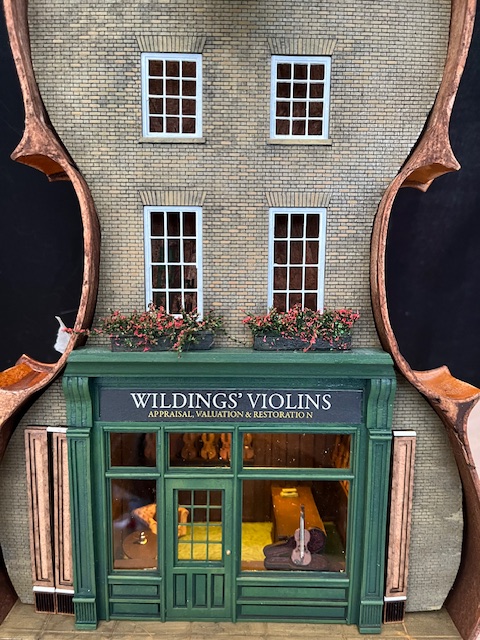
The inspiration behind my latest novel, The Violin Maker’s Secret, was drawn from the lives of luthiers down through the ages, who crafted sublime instruments from very ordinary pieces of wood. The juxtaposition of carpentry tools like chisels, hand planes and callipers, crafting priceless violins to be played by maestros in concert halls was fascinating to me. Even more so, the discovery of a man who became known as the Irish Stradivarius, Thomas Perry, who had his workshop in Temple Bar in the late 1700s. Little did I know then that my story would find its way to a workshop in Huddersfield, where miniaturist Lee Robinson would sit at his workbench to create a very unique model for the cover of my book.
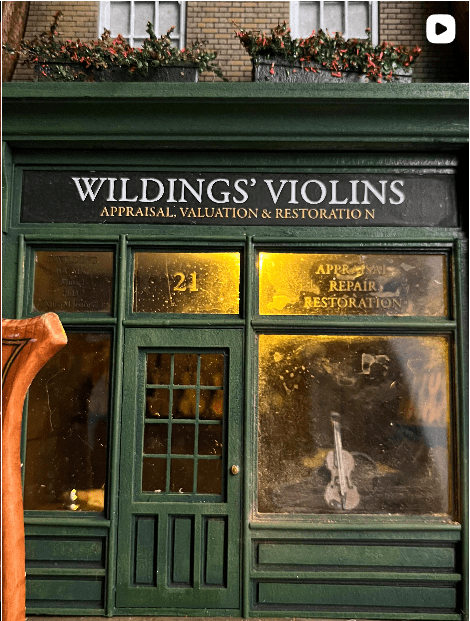
For an author, the book cover is one of the most exciting parts of the process. I’m fortunate in that my publisher welcomes my ideas and after some brainstorming, One More Chapter’s Art Director, Lucy Bennett, commissioned a model maker to build a miniature shop inside an actual violin.
“As soon as I found Lee, I knew he was perfect for the project, and this was going to be a stunning cover, in fact, it’s probably one of my favourites!”
Cue Lee Robinson, a model maker who recently featured in the BBC’s new television series ‘The Marvellous Miniature Workshop’. He sourced a second-hand violin and set to work on creating Wilding’s Violin shop – a place that, up to that point, had only existed on the page. As model maker Lee himself said:
“The fact that Harper Collins still engages with actual artists, spending carefully considered time over the process of creating art… I was absolutely thrilled with the commission.”
As for me, the alchemy of seeing my story interpreted through another artist’s skill and craftsmanship was an amazing experience. The cover perfectly reflects the time and commitment required to build a violin, to learn how to play one, and even to source the correct wood. (Stradivarius was said to have sourced his in the ‘musical forest’, high in the Italian Alps). Then there is the novel itself, which took 18 months to write and research, and that’s before the editing process. The etymology of the word “wordsmith” which originated in the late 19th century, is derived from the term “smith” a craftsperson, describing someone who crafts words skillfully. Our imagination and creativity are the tools of our trade. However, these time-honoured traditions of apprenticeship and honing one’s craft are now being undermined by a technology that seeks to replace us altogether.
It’s almost impossible to escape the ubiquitous bombardment of generative AI companies, who hope to seduce with the shiny poisoned apple of churning out artworks in seconds. It’s inevitable, the messaging tells us; you don’t want to get left behind. It speaks about the creative process as though it is something getting in the way of our creativity, slowing us down, rather than being the path that leads us to it. Then again, it’s no surprise that a capitalist venture focuses on the product and speed to market, rather than the process. They are missing the entire point, the reason most of us pick up a pen in the first place: the act of doing the thing, the devotion to it, is where the meaning lies. It is this act of human endeavour, our urge to make things that, as the poet and philosopher John O’Donoghue put it, ‘brings our invisible world to expression’.
When it came to light that my books (along with millions of others) had been essentially torrented by Meta, “allegedly”, from a pirate site in what was the largest copyright theft in history, I felt furious. I didn’t want my words, my intellectual property and everything I had experienced in my life that led to me writing them, trapped in some nightmare machine. It is completely unethical and devalues the profession. I also felt powerless in the face of this juggernaut that is smashing through copyright and privacy laws, while the data centres that power it are having an untold impact on our environment. A recent UN report described Ireland as a ‘cautionary tale’, stating that we are already using over 22 per cent of our electricity. This, at a time when the European Commission has referred Ireland to the ECJ for failure to comply with EU rules on environmental impact assessments over peat cutting. The hypocrisy is galling.
Aside from these immediate concerns and the fact that it is all being done without consent, there is something more insidious going on. As James Bradley (author and critic) said back in 2024, “AI isn’t about unleashing our imaginations, it’s about outsourcing them”. And he was spot on. Sam Altman said the quiet part out loud earlier this year when he shared that he sees ‘a future where intelligence is a utility like electricity or water and people buy it from us on a meter.’
What a chilling, dystopian view. However, you can’t shortcut creativity without stripping its soul. Ever since Generative AI began trading in stolen emotions and invading the art world (one can’t help but shudder at the memory of OpenAI’s ‘Ghibli-style’ trend last year), I have been wondering why? What is the goal? I can understand how it could be useful in time-consuming tasks like number crunching, but why try to undermine our most basic instinct of storytelling? Perhaps the answer can be found in this quote from Brenda Ueland:
“Why should we all use our creative power….? Because there is nothing that makes people so generous, joyful, lively, bold and compassionate, so indifferent to fighting and the accumulation of objects and money.”
Perhaps naively, we used to believe in a future where robots would do the housework, not write novels. With each new day, a new AI controversy hits the literary world. It began earlier in the year with Hachette pulling a debut novel for alleged AI use, which was apparently detected by… AI. Granta Magazine ended its partnership with the Commonwealth Foundation and will no longer publish the winner of the Short Story Prize following accusations of AI use. The “Expert Review” launched by Grammarly, offering AI-generated writing advice imitating famous writers, both living and dead, all created without their permission, has been removed and is facing a lawsuit. But it’s the lingering doubt created by AI use that damages all of us. The only solution brought forward by The Society of Authors was to put a sticker on your book saying ‘Human Authored’. Shouldn’t it be the other way around, and the AI books should have a sticker warning the reader? The bigger question underlying all of this is, if you don’t enjoy writing in all of its messy glory, then why write at all?
I have yet to see how any of us benefit from AI. So far, it seems to be putting people out of work, pushing up the cost of living and guzzling all our water. Even the Pope is worried, calling for AI to be ‘disarmed’.
It’s not just about the normalisation of taking things without asking (i.e., theft) but the quiet erosion of respect for the artistic process; a process which works on us as much as we work on it. Writers need belief to write, publishers need to believe in the work in order to get it on the shelves, and readers need to believe that what they’re reading is authentic. This is the ecosystem that makes the book world work. Trust. Trust that when you read a book, you are truly stepping into the author’s world, not a predictive text version of it. There is a visceral sense of betrayal out there when it becomes clear that, as consumers, we are being convinced to accept slop and be okay with it. Perhaps then, it’s no surprise to see a growing nostalgia for simpler times, with analogue bags, dumb phones and a newfound appreciation for real art.
It’s wonderful to see publishers invest in their authors, audiobook narrators and cover designers, because readers deserve the very best of what we can do. If I am going to ask them to hand over their hard-earned money to buy my book, then I am going to keep my side of the bargain and work night and day to produce something worthy of their time. That’s the deal.
For my part, I’ve been writing since 2005 – long before I ever signed a publishing contract. It wasn’t a get-rich-quick scheme. It was something I needed to do – an outlet for my creativity, a mirror to explore my view of the world, a refuge and a form of connection with my fellow humans. And now, it’s a platform for me to express my talent that I’ve worked hard to nurture. Writing has been the most rewarding experience of my life and I don’t want to see that taken away from the writers coming up behind me. Authors cannot build a career in the shadow of a technology that convinces them they aren’t good enough. In the end, it robs all of us, one way or another.
On a more hopeful note, the backlash against the use of AI, especially by the younger generation, gives me so much hope that we can still influence how our future is shaped, rather than being haunted by the ghost of one that risks being stolen by the Broligarchs. Perhaps they underestimate us. For as long as I can remember, someone somewhere has been declaring the death of the novel. And yet, its heart continues to beat. I believe Doris Lessing, the Nobel Prize-winning author who lived through wars, dictators and every manner of social change, said it best:
‘It is our stories that will recreate us, when we are torn, hurt, even destroyed. It is the storyteller, the dream-maker, the myth-maker, that is our phoenix, that represents us at our best, and at our most creative.’

